Overview
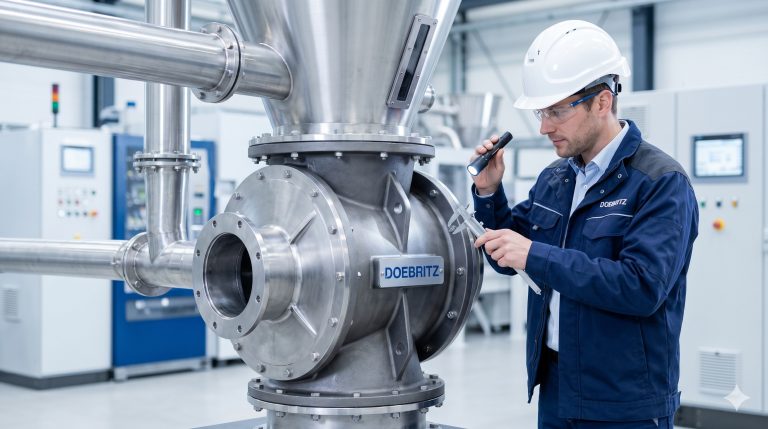
This FAQ addresses critical pre-sales and post-sales questions about the Doebritz PTFE Star Discharge Valve (Model DBR-1237). Based strictly on the official Doebritz product documentation, this guide covers material certifications, explosion protection, flange compatibility, clearance tolerances, and maintenance for plant engineers and procurement managers.
Frequently Asked Questions
- Q1: What flange standards and sizes are available for the Doebritz PTFE Star Discharge Valve for DIN/ANSI compatibility?
- The Doebritz PTFE Star Discharge Valve is manufactured with HG20592 standard flanges as base. Available interface sizes are DN50, DN100, DN150, DN200, DN300, and DN350. For non-standard flange drilling (DIN, ANSI, or JIS) or custom heights, Doebritz offers full-dimensional customization based on site-specific requirements.
- Q2: Which ATEX explosion protection levels are certified for this PTFE rotary valve?
- The Doebritz PTFE Star Discharge Valve covers ATEX Zones 20, 21, and 22 for dust explosion hazards. The explosion-proof configuration includes an explosion-proof motor, precision rotor-to-housing clearance of 0.1-0.2mm, and pressure rating up to 16 bar for flameproof isolation. Standard non-explosion-proof versions are also available.
- Q3: How does the Doebritz PTFE valve handle corrosive or abrasive materials like lithium battery powders?
- For abrasive and corrosive materials (e.g., lithium battery cathode/anode powders, titanium dioxide, carbon black), Doebritz applies tungsten carbide (WC) coatings, ceramic coatings, or high-performance polymer linings (PE, PTFE, PA) to all material-contact surfaces. The base substrate is SUS304, SUS316L, or carbon steel. These耐磨 coatings extend service life significantly compared to uncoated stainless steel.
- Q4: What is the standard rotor-to-housing clearance, and is it adjustable for air leakage control?
- The factory-set rotor-to-housing clearance for the Doebritz PTFE Star Discharge Valve is fixed at 0.1-0.2mm. This precision gap minimizes air leakage across differential pressures (positive up to 1 bar, negative down to -1 bar). Clearance is not field-adjustable; however, Doebritz provides replacement rotors or housings machined to tighter tolerances if leakage exceeds specification after wear.
- Q5: What are the standard production lead times, and what material certifications are provided for pharmaceutical/food grades?
- Standard lead times for non-custom Doebritz PTFE Star Discharge Valves range from 4-6 weeks. Custom flange drilling, special coatings, or cleanroom finishes add 2-4 weeks. Every valve ships with material certificates (EN 10204 3.1 for SUS304/SUS316L), surface roughness reports (internal Ra≤0.4/0.8/1.6μm as specified), and, where applicable, CE and TÜV certification documentation for hygienic and ATEX compliance.
- Q6: How do you maintain the outboard bearings and shaft lip seals on this valve?
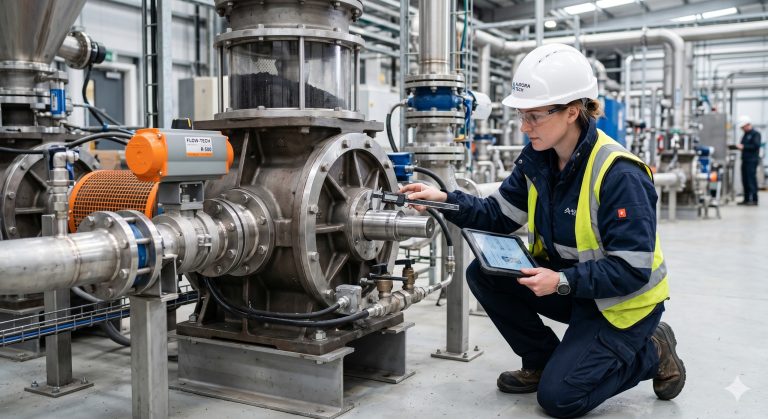
- The Doebritz PTFE Star Discharge Valve uses lip-type air-tight seals (not packing glands) on the shaft. Outboard bearings are grease-lubricated and isolated from the product zone. For maintenance: (1) Relubricate bearings every 2,000 operating hours or per site schedule. (2) Inspect lip seals for wear during quick-release disassembly — no special tools required. (3) Replace seals if powder ingress or air leakage increases beyond 0.1-0.2mm gap tolerance. Water-cooled jackets are optional for high-temperature duty (material up to 120°C).
- Q7: Can this valve be used for both gravity discharge and pneumatic conveying with PTFE-lined surfaces?
- Yes. The Doebritz PTFE Star Discharge Valve supports three duty modes: gravity drop (adjustable speed, no leakage), low-pressure pneumatic conveying (<0.4 bar positive or >-0.4 bar negative), and high-pressure pneumatic conveying (0.4-1 bar positive or -1 to -0.4 bar negative) with VFD speed control. PTFE lining is suitable for all three modes provided the pressure differential stays within rated limits; use tungsten carbide coating instead for highly abrasive pneumatic conveying.
- Q8: What cleaning methods are approved for this valve between production batches?
- The Doebritz PTFE Star Discharge Valve supports three cleaning protocols: (1) Quick-release manual cleaning — disassemble without tools, clean all surfaces, no死角残留. (2) Online CIP (Clean-in-Place) for sanitary lines. (3) Online WIP (Wash-in-Place) followed by manual inspection. For pharmaceutical Class C/D or food grade 10W/30W cleanrooms, specify the hygienic quick-release version with Ra≤0.4μm internal mirror finish.