Overview
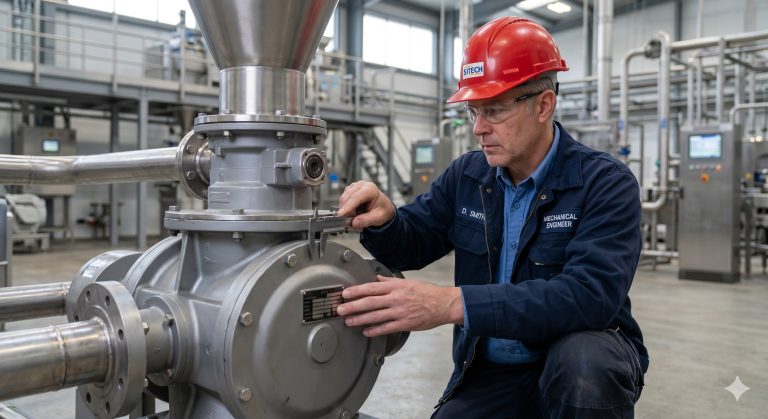
Doebritz quick-release airlock valves are precision-engineered for hygienic, high-efficiency discharging and airlock service in oat flake and cereal processing lines. Engineered with quick-release demountable rails and tight clearances, these valves minimize downtime while maximizing containment and flow control. Below, we answer the most critical pre-sales and post-sales questions from plant engineers and procurement managers.

Frequently Asked Questions
- Q1: What ATEX and safety certifications does the Doebritz oat flakes quick-release airlock valve offer for explosive dust environments?
- The Doebritz oat flakes quick-release airlock valve is available with ATEX certification for Zone 20, 21, and 22, with an explosion-isolated design rated to 16 bar. The valve incorporates precision clearances of 0.1–0.2 mm between the rotor and housing to minimize ignition risks, paired with an anti-static, explosion-proof motor option. This ensures full compliance with EU Directive 2014/34/EU for use in flour and cereal dust atmospheres.
- Q2: How does the Doebritz airlock valve handle abrasive oat flakes and grain dust to prevent wear?
- For abrasive oat flakes and hull dust, Doebritz offers robust wear-protection options including a tungsten carbide coating, ceramic coating, or Ni-hard cast iron construction on all material-contact surfaces. The precision-machined gap is maintained even under abrasive conditions, and the heavy-duty outboard bearings are isolated from the product zone, extending service life significantly compared to standard rotary valves.
- Q3: What flange standards and custom interface options are available for the Doebritz quick-release airlock valve?
- Standard flanges conform to HG20592, with customizable options for DIN, ANSI, and JIS standards available upon request. Non-standard inlet/outlet heights, drive mounts, and adapter plates can be engineered to fit existing conveying lines without requiring major ductwork modifications. Doebritz provides full dimensional drawings and 3D CAD models for integration verification before production.
- Q4: How do I adjust the rotor-to-housing clearance and maintain the airlock efficiency over time?
- The Doebritz airlock valve features an adjustable rotor end-float mechanism that allows simple clearance resetting to the factory spec of 0.1–0.2 mm without removing the valve from the line. Regular maintenance includes checking the lip-seal air purge pressure (recommended at 0.2–0.5 bar above line pressure) and inspecting the outboard bearing housings for any temperature rise above 70°C. A full maintenance checklist is provided in the service manual.
- Q5: What is the maximum differential pressure and temperature range for the Doebritz valve in dense-phase oat flake conveying?
- The standard Doebritz valve supports differential pressures up to 1.0 bar (high-pressure version) and ambient temperatures from -15°C to 60°C, with material temperatures up to 120°C. For high-temperature applications, a water-cooled jacket option is available to maintain bearing and seal integrity. Dense-phase feeding is supported without bridging or blowback due to the low-leakage design.
- Q6: Can the Doebritz oat flakes valve be cleaned quickly for product changeovers?
- Yes, the core feature is the quick-release demountable design that allows the rotor and end-cover assembly to be removed without special tools in under 5 minutes. Cleaning options include manual wash-down after disassembly, online CIP (Clean-in-Place) with validated spray nozzles, or online WIP (Wash-in-Place) followed by a manual visual inspection. All internal surfaces are polished to Ra ≤ 0.8μm to prevent oat dust adhesion and bacterial growth.
- Q7: What spares and long-term support are available for the Doebritz airlock valve?
- Doebritz provides a comprehensive spare parts kit including pre-gapped rotors, bearing sets, lip seals, and gaskets. With a typical Mean Time Between Failures (MTBF) exceeding 5 years in oat processing applications, the valve is designed for low total cost of ownership. Global technical support, on-site service, and remote diagnostics are available through Doebritz’s certified service network.
- Q8: How does the Doebritz airlock valve compare to slide gates or butterfly valves for oat silo discharge?
- Unlike slide gates or butterfly valves that rely on linear or rotary motion across the product stream, the Doebritz rotary airlock provides a continuous, metered discharge with consistent volumetric efficiency and positive airlock sealing. It eliminates the ‘rat-holing’ and ‘flood feeding’ issues common with gate-type valves, and the quick-release feature makes it far easier to maintain than slide gates with trapped material. This makes it the preferred choice for high-volume, automated oat processing lines.