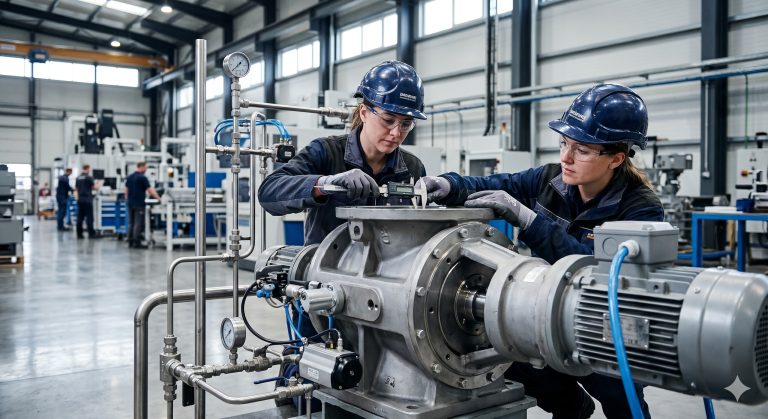
Overview
Doebritz quick-release rotary valves are widely specified for wheat flour handling across food, baking, and ingredient processing plants. As a star discharge valve or airlock feeder, the DBR-1237 gravity model must meet strict hygiene, explosion safety, and metering accuracy demands while conveying fine, potentially abrasive flour powders. This FAQ answers the most common technical and procurement questions from plant engineers and maintenance managers about Doebritz wheat flour rotary valves, ensuring you select, operate, and maintain the equipment for optimum performance and compliance.

Frequently Asked Questions
- Q1: What rotor-to-housing clearances are standard for a Doebritz wheat flour star discharge valve, and why are they critical?
- The standard rotor-to-housing clearance for a Doebritz wheat flour star discharge valve is precisely set between 0.1mm and 0.2mm. This tight clearance is critical because it minimizes air leakage across the rotor, ensuring efficient airlock sealing and maintaining stable pneumatic conveying pressure. For fine wheat flour, which can fluidize easily, this controlled clearance also prevents excessive blowback and reduces the risk of material degradation or dust emissions at the discharge point.
- Q2: Can the Doebritz DBR-1237 wheat flour rotary valve handle ATEX Zone 20/21/22 classified areas?
- Yes, the Doebritz DBR-1237 star discharge valve is fully available with ATEX certification covering Zone 20, Zone 21, and Zone 22 hazardous areas. For Zone 20 (continuous presence of explosive dust atmosphere), the valve is built with an explosion-proof motor, a pressure-resistant housing rated up to 16 bar, and precision clearances (0.1-0.2mm) to prevent ignition sources. It also meets the requirements for dust explosion isolation, making it a safe choice for pneumatic conveying lines handling wheat flour in enclosed milling or mixing zones.
- Q3: What flange standards are available for connecting the Doebritz wheat flour rotary valve to my existing ductwork?
- Doebritz provides the wheat flour star discharge valve with HG20592 standard flanges as a baseline. For international projects or plants with imported equipment, we also offer matching to DIN and ANSI flange standards upon request. Connection sizes are available from DN50 through DN350, ensuring compatibility with most new or existing flour handling lines. This flexibility simplifies retrofitting and reduces the need for custom adapters.
- Q4: How does the Doebritz star discharge valve handle the abrasive nature of wheat flour and prevent wear?
- Wheat flour, while soft, can be mildly abrasive over long periods, particularly if it contains bran particles or hard wheat endosperm fragments. The Doebritz DBR-1237 addresses this with optional wear-protection coatings. You can specify the rotor and internal housing with a tungsten carbide coating, a ceramic coating, or a high-performance polymer layer (such as PE or PTFE). These surface treatments significantly extend component life by reducing erosive wear, maintaining the critical 0.1-0.2mm clearance for longer, and lowering total cost of ownership in high-throughput flour milling applications.
- Q5: What cleaning protocols are supported for the Doebritz wheat flour valve to meet food safety standards?
- The Doebritz quick-release star discharge valve is designed for hygienic food processing and supports three cleaning protocols: manual cleaning after quick disassembly (no special tools required); full online CIP (Clean-in-Place) cleaning using automated spray systems; and online WIP (Wash-in-Place) cleaning followed by a manual inspection and verification step. The valve’s demountable design, along with the available 316L stainless steel construction and mirror or Ra≤0.4μm internal finishes, prevents flour residue buildup and eliminates cross-contamination risks, meeting GMP and HACCP requirements for wheat flour production.
- Q6: Can the Doebritz wheat flour star discharge valve be used for both gravity discharge and pneumatic conveying?
- Yes, the Doebritz DBR-1237 star discharge valve is a versatile unit that performs reliably in both gravity discharge (under silos, bins, or dust filters) and positive/negative pressure pneumatic conveying systems. For gravity service, it provides steady, adjustable flow with no leakage or powder bypass. For pneumatic conveying, it handles low-pressure (below 0.4 bar) and high-pressure (0.4 to 1 bar) conditions with a variable frequency drive (VFD) to match conveying rates. This dual-use capability makes it an ideal choice for flour mills that require flexible material routing between storage, packaging, and further processing.
- Q7: What is the recommended maintenance schedule for bearings and shaft seals on the Doebritz wheat flour rotary valve?
- For wheat flour applications, Doebritz recommends inspecting the outboard bearings and lip-type air-tight shaft seals every 3-6 months, depending on operational hours and flour dust exposure. The outboard bearing design isolates the bearings from the product zone, preventing flour ingress and extending bearing life. The lip seals should be checked for wear and replaced if any leakage is detected. In high-duty cycles, we advise a full service including seal replacement and clearance verification (0.1-0.2mm) annually. Doebritz offers spare parts kits and engineering advisory services to simplify this maintenance.
- Q8: Is the Doebritz wheat flour valve suitable for automated batch weighing and recipe formulations?
- Absolutely. The Doebritz DBR-1237 star discharge valve is fully compatible with PLC automation and frequency inverter speed control. This enables precise batch metering, recipe-based discharge rates, and automated配料 (batching) for flour-based products. The VFD adjusts rotor speed linearly with the required flow rate, ensuring repeatable fill volumes for hoppers, mixers, or packaging lines. Its low leakage and consistent volumetric efficiency make it a preferred airlock feeder in automated flour handling systems where dosing accuracy is paramount.