Overview
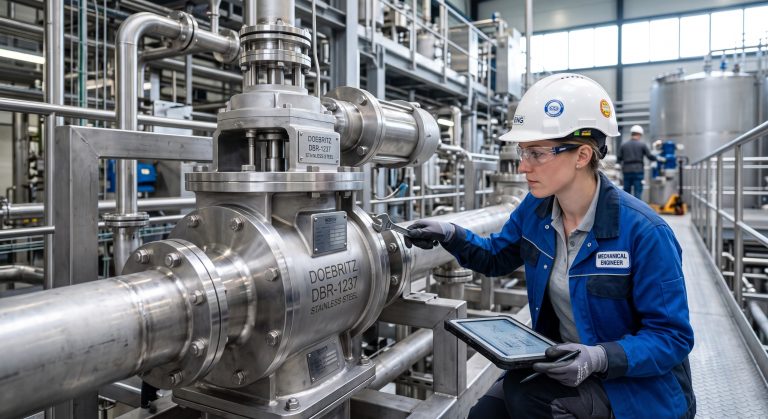
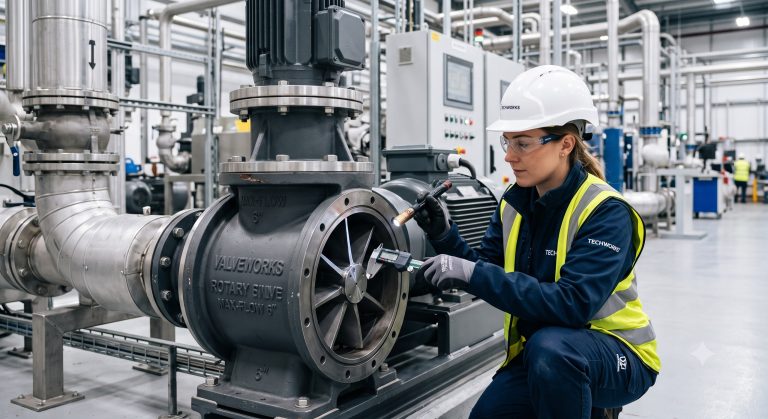
At Doebritz, quality control is not an afterthought—it’s engineered into every stage of manufacturing for our DBR-1237 Gravity Quick-Release Rotary Valve. From incoming raw material verification to final assembly and ATEX pressure testing, our workshop protocols ensure that every valve meets the exacting demands of food, pharmaceutical, chemical, and new energy applications. Here are the most frequently asked questions from plant engineers and procurement managers regarding our workshop QC process.

Frequently Asked Questions
- 1. What material certifications and traceability do you provide for the Doebritz DBR-1237 gravity rotary valve?
- Every Doebritz DBR-1237 gravity rotary valve is shipped with full mill test certificates (EN 10204 3.1) for the base materials—SUS304, SUS316L, or carbon steel. We provide complete chemical composition analysis and mechanical property reports that are fully traceable to the heat number stamped on each valve component.
- 2. How does your workshop verify the critical rotor-to-housing clearance on the DBR-1237 gravity rotary valve?
- The rotor-to-housing clearance is verified using precision bore gauges and coordinate measuring machines (CMM) at multiple points around the circumference. For the DBR-1237 gravity rotary valve, we hold a standard clearance of 0.1–0.2 mm, with each unit’s measurement recorded in a dimensional inspection log that is included with the final quality pack.
- 3. What ATEX compliance verifications are performed in your workshop on the DBR-1237 gravity rotary valve?
- For ATEX-certified versions of the DBR-1237 gravity rotary valve, we conduct a documented 16 bar hydrostatic pressure test on the valve housing. Our workshop also performs a detailed spark path and gap analysis, verifies the anti-static construction of the rotor and seals, and checks all electrical components—including the explosion-proof motor—against the Zone 20/21/22 classification requirements.
- 4. How do you ensure the flange dimensions of the DBR-1237 gravity rotary valve match our existing piping (DIN/ANSI)?
- All flanges on the Doebritz DBR-1237 gravity rotary valve are machined in-house using CNC equipment and are inspected with go/no-go gauges and bolt-hole pattern templates. We support both HG20592 (the standard) and custom DIN/ANSI flange configurations, and we perform a full bolt-hole alignment and flatness check before the valve leaves our workshop.
- 5. What non-destructive testing (NDT) is applied to the DBR-1237 gravity rotary valve components?
- Depending on the application, our workshop applies dye penetrant testing (PT) on critical welds and magnetic particle inspection (MT) on ferrous components. For our DBR-1237 gravity rotary valves destined for high-pressure or hygienic applications, we also perform visual inspection with borescopes to ensure internal surfaces are free of cracks or porosity.
- 6. Do you test the DBR-1237 gravity rotary valve under pressure before shipping to verify the airlock seal?
- Yes. Each Doebritz DBR-1237 gravity rotary valve undergoes a functional air leakage test at the specified differential pressure (up to 1 bar positive or -0.4 bar negative). We measure the leakage rate across the rotor and seals to ensure it stays below the guaranteed maximum, verifying that the precision gap and lip seal air-tight assembly perform to specification.
- 7. What surface finish and coating inspections are performed for the DBR-1237 gravity rotary valve?
- We inspect the internal surface finish using a surface roughness tester to confirm Ra values of ≤0.4 μm (mirror), ≤0.8 μm, or ≤1.6 μm as required. For carbide, ceramic, or polymer coatings, we check adhesion and thickness with a digital coating thickness gauge and verify visual coverage under high-intensity lighting to ensure no pinholes or bare spots.
- 8. How do you handle quality documentation and provide shop test reports for the DBR-1237 gravity rotary valve?
- Each Doebritz DBR-1237 gravity rotary valve comes with a comprehensive Quality Assurance Package that includes the material certificates, dimensional inspection records, NDT reports, pressure test logs, and a final release certificate. We provide these documents digitally or in hard copy with the shipment, and they are retained in our archive for full traceability.