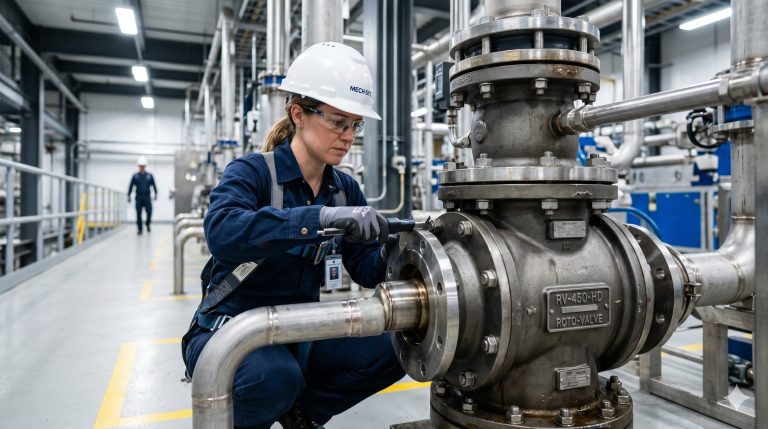
Overview
In sanitary milk powder processing, the star discharge valve must prevent cross-contamination, maintain airtight sealing under differential pressure, and support rapid cleaning validation. The Doebritz DBR-1237 quick-release rotary valve (star discharge valve) is specifically engineered for dairy powder applications with 316L mirror-polished internals, CIP/WIP cleanability, and ATEX Zone 20-22 certifications. Below are the most frequently asked technical and procurement questions from B2B plant engineers and maintenance managers.

Frequently Asked Questions
- Q1: What rotor-to-housing clearance does the Doebritz milk powder star discharge valve maintain for airtight sealing?
- The Doebritz DBR-1237 star discharge valve maintains a precision rotor-to-housing clearance of 0.1–0.2mm. This tight tolerance minimizes air leakage across the valve body under both positive pressure (up to 1 bar) and negative pressure (down to -1 bar), ensuring stable pneumatic conveying and preventing blowback that could fluidize milk powder and reduce metering accuracy.
- Q2: Is the Doebritz star discharge valve compliant with ATEX for milk powder dust explosion zones?
- Yes, the Doebritz DBR-1237 is certified for ATEX Zones 20, 21, and 22. Explosion-proof configurations include an explosion-proof motor, pressure rating up to 16 bar for isolated containment, and precision 0.1–0.2mm clearances to prevent flame propagation. This makes it suitable for milk powder conveying lines where organic dust explosion risks exist.
- Q3: What flange standards are available for the Doebritz milk powder rotary valve?
- The Doebritz DBR-1237 star discharge valve is supplied with HG20592 flanges as standard (compatible with DIN/EN equivalents). Custom flange matching to ANSI, JIS, or other national standards is available upon request during the ordering process, ensuring seamless integration into existing milk powder silo or conveying systems.
- Q4: How does the quick-release design support CIP cleaning in milk powder applications?
- The Doebritz quick-release demountable design allows tool-free disassembly of the end cover and rotor, enabling full access to internal surfaces. It supports online CIP (Clean-in-Place), online WIP (Wash-in-Place) followed by manual inspection, or complete manual cleaning. The 316L stainless steel mirror finish (Ra ≤ 0.4μm) eliminates dead zones where milk powder residue could accumulate, meeting strict dairy hygiene validation requirements.
- Q5: What shaft sealing technology prevents milk powder leakage into the bearing housing?
- The Doebritz DBR-1237 employs lip seal air-tight shaft seals (lip sealing ring with air purge capability). This air-purged sealing system prevents fine milk powder ingress into outboard bearings, dramatically extending maintenance intervals. Outboard bearing design further isolates bearings from the product zone, eliminating lubricant contamination risks.
- Q6: Can the Doebritz star discharge valve handle high-temperature milk powder up to 120°C?
- Yes, the standard Doebritz DBR-1237 handles material temperatures from 0°C to 120°C and ambient temperatures from -15°C to 60°C. For sustained high-temperature milk powder conveying (e.g., spray-dried powder at 80-100°C), an optional water-cooling jacket on the valve housing maintains rotor clearance stability and prevents thermal binding.
- Q7: What surface finish options are available for FDA compliance in milk powder service?
- The Doebritz DBR-1237 offers internal surface finishes including mirror polish with Ra ≤ 0.4μm, Ra ≤ 0.8μm, or Ra ≤ 1.6μm. For milk powder and other dairy applications, the Ra ≤ 0.4μm mirror finish on 316L stainless steel is recommended to prevent bacterial adhesion and enable rapid visual cleanliness inspection. FDA-compliant elastomers are used for all seals.
- Q8: How do I size a Doebritz star discharge valve for a milk powder silo discharge application?
- Sizing depends on milk powder bulk density (typically 0.4–0.6 g/cc), required throughput (kg/h or m³/h), and differential pressure across the valve (0–1 bar). Doebritz offers standard port sizes DN50, DN100, DN150, DN200, DN300, and DN350. Variable frequency drive (VFD) speed control allows flow rate adjustment. Contact Doebritz technical support with your specific silo discharge or pneumatic conveying parameters for a certified sizing recommendation.