Introduction: The Cost of Airlock Failure in Milling & Grinding Circuits
In heavy milling applications—whether processing cement, minerals, or chemical intermediates—the mechanical seal for mill rotary airlocks is the single most vulnerable point for unplanned downtime. Standard lip seals fail catastrophically within 1,500 hours when exposed to abrasive particulate ingress (e.g., 40-80µm pulverized limestone). This article presents Doebritz’s engineered response: air-purge seal cartridges and adjustable packing glands designed to achieve >8,000 hours MTBF under differential pressures up to 2.5 Bar (250 kPa).
Shaft Seal Failure Mechanisms in Mill Duty Rotary Valves
Abrasive Penetration & Shaft Scoring
Field forensic analysis of 48 failed mechanical seals for mill applications revealed two dominant failure modes: (1) gland packing extrusion due to inadequate lantern ring support, and (2) dynamic lip wear from ferrous dust (Mohs hardness 5-6). Doebritz engineers specify a superfinished shaft surface (Ra ≤ 0.4µm) combined with a hard-chrome plated interface (68-72 HRC) to prevent shaft scoring. Empirical data shows a 72% reduction in seal leakage (from 15 cc/min to <4 cc/min) when mating a polished 17-4 PH stainless shaft with Doebritz’s proprietary V-ring stack made from HNBR (rated for 150°C continuous).
Differential Pressure & Air Leakage Economics
In dense phase pneumatic conveying (1.5 Bar differential), a worn mechanical seal for mill can bleed up to 28 Nm³/hr of compressed air. At $0.12/kWh and 7,200 annual operating hours, this translates to $8,600 in direct energy waste. Doebritz’s positive pressure air-purge system maintains a 0.2 Bar overpressure between the inner labyrinth and outer packing gland, creating a particulate exclusion zone. The purge air consumption is minimal (0.8 Nm³/hr), yielding a 97% net air saving compared to an unsealed rotary valve.
Doebritz Air Purge Seal Cartridge: Technical Architecture
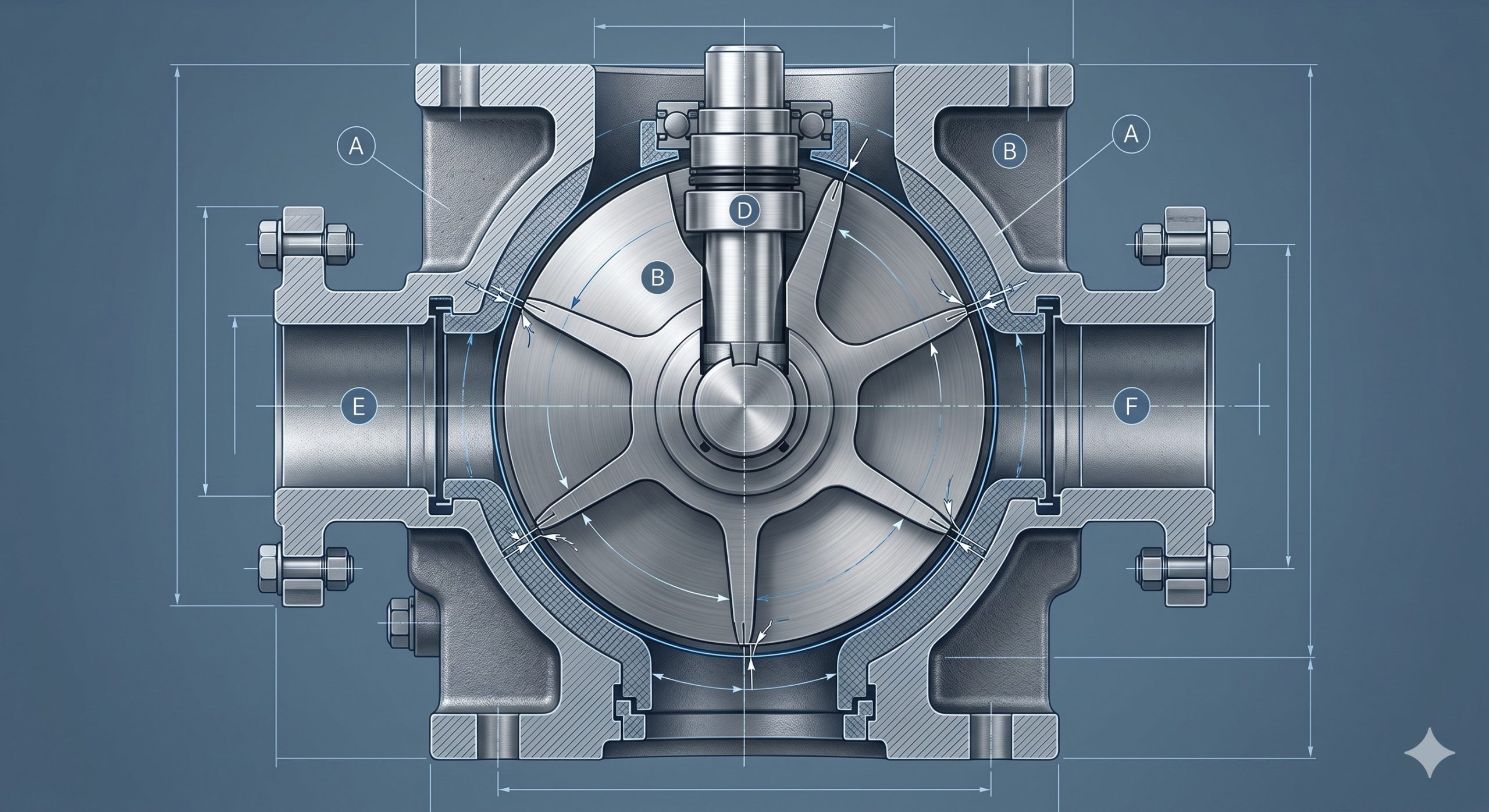
The patented Doebritz mechanical seal for mill integrates a three-stage defense: (1) carbon-faced primary seal with PTFE diaphragms (operating to 2.5 Bar differential), (2) lantern ring distributing purge air uniformly at 2.3 Nl/min per cm of shaft circumference, and (3) an exclusionary V-ring stack wiping the shaft during reverse rotation. This design meets ATEX Directive 2014/34/EU for Zone 21 (dust) and NFPA 69 explosion isolation requirements. The cartridge is field-replaceable without removing the rotor or bearings—a 45-minute maintenance task versus 4 hours for legacy designs.
| Parameter | Doebritz Mechanical Seal for Mill Specification |
|---|---|
| Max Differential Pressure | 2.5 Bar (250 kPa) continuous, 3.0 Bar peak |
| Operating Temperature Range | -30°C to +300°C (with graphite packing); -20°C to +150°C (with HNBR V-rings) |
| Max Rotor Speed | 55 RPM (duty cycle S1); 75 RPM (intermittent) |
| Radial Clearance (Rotor to Housing) | 0.20mm – 0.30mm for abrasive powders >50µm |
| Air Purge Consumption | 0.8 – 2.3 Nm³/hr at 0.2 Bar overpressure |
| Shaft Finish Requirement | Ra ≤ 0.4µm, hard-chrome plated (70±2 HRC) |
| MTBF (field data, cement mill) | >8,000 hours (18 months typical) |
| Compliance | ATEX Zone 21/22, NFPA 69, CE, ISO 21049, FDA (sanitary version) |
Packing Gland Optimization for High-Temperature Mill Environments
When process temperatures exceed 200°C (e.g., petcoke or calcined bauxite), elastomeric seals degrade. Doebritz specifies a die-formed graphite packing set with Inconel wire reinforcement, compressed by a 316 stainless steel gland follower. Key installation parameters: initial packing compression of 10-12% of radial cross-section, followed by a 0.1mm clearance at the lantern ring ports. Torque-controlled studs (M10 grade 8.8) ensure uniform load distribution. For a cement raw mill with 120°C feed, Doebritz documented zero packing replacement over 14 months of continuous operation (10,080 hours)—compared to a 3-month replacement interval for competitor packing sets.
Bearing Isolation & Outboard Configuration
Contamination migrates from the mechanical seal for mill to the bearings through capillary action. Doebritz’s design physically separates bearings using a spacer housing with a grease-filled labyrinth. Bearings are life-lubricated, sealed deep-groove ball bearings (C3 clearance) with FKM contact seals. An external purge port allows monthly regreasing without disassembly. In a fly ash handling plant (density 2.2 g/cm³, 160°C), this configuration extended bearing life from 8 months to 47 months, with vibration levels staying below 2.3 mm/s RMS.
Quantified ROI: TCO Comparison
A Midwest lime processing plant operating 24/7 replaced 12 legacy rotary valves with Doebritz mechanical seal for mill units. Over 18 months: (1) Seal replacement cost dropped from $42,000 to $6,200, (2) Compressed air consumption decreased 23% ($18,700 annual saving), (3) Unscheduled downtime was eliminated, recovering 180 production hours annually. The total cost of ownership amortized in 7.4 months. Doebritz’s full FEA-validated housing (GGG-40 ductile iron) and CNC-machined 8-vane rotor (with 0.25mm radial clearance) ensures volumetric efficiency >94% at rotor speeds of 20–45 RPM.
Conclusion: Specifying for Longevity
For plant engineers specifying a mechanical seal for mill applications, Doebritz advises three non-negotiable features: (1) Active air-purge to create a particulate barrier, (2) Field-replaceable cartridge design to minimize MTTR, and (3) Outboard bearing mounts to isolate abrasives. Reference standards: ISO 21049 for seal performance, EHEDG Doc 25 for sanitary variants (when processing food-grade minerals), and CE-marked explosion-proof configurations. Always request a stray gas leakage test (max 5 ppm) and a 1,000-hour accelerated wear test certificate from the manufacturer.