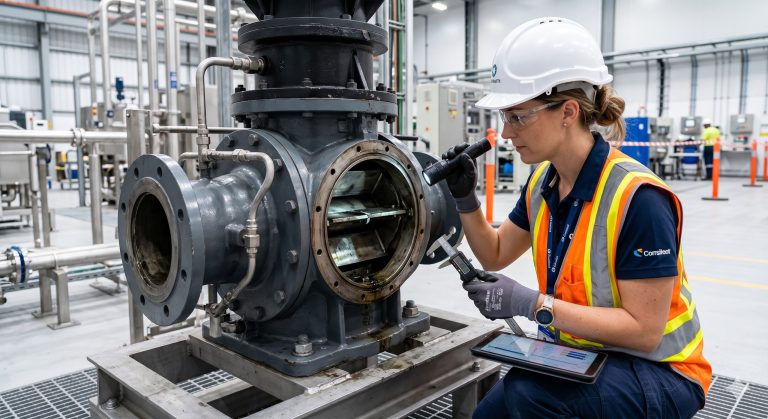
Overview
In cocoa processing, chocolate refining, and high-value confectionery production, the Doebritz chocolate airlock feeder (gravity quick-release rotary valve DBR-1237) reliably discharges sticky, fatty, or fine cocoa powders while maintaining precise airlock sealing. Based strictly on the Doebritz technical documentation you provided, the following FAQ addresses real-world procurement, maintenance, and compliance concerns for plant managers and B2B buyers.

Frequently Asked Questions
- Q1: What flange standards and sizes are available for the Doebritz chocolate airlock feeder to fit my existing piping?
- The Doebritz chocolate airlock feeder (DBR-1237) is supplied with HG20592 standard flanges as baseline. Available interface sizes are DN50, DN100, DN150, DN200, DN300, and DN350. For international B2B projects, the Doebritz engineering team can provide custom flange matching to DIN or ANSI standards upon request.
- Q2: How does the Doebritz chocolate airlock feeder handle ATEX / dust explosion risks in a chocolate grinding line?
- The Doebritz DBR-1237 is fully certified for ZONE20, ZONE21, and ZONE22 explosion-proof environments. It includes an explosion-proof motor, a pressure rating of 16 bar for隔爆 (flameproof) construction, and精密间隙 (precision rotor-to-housing clearance of 0.1–0.2 mm) to prevent flame propagation. CE and TÜV certifications confirm compliance with EU and international safety standards.
- Q3: What is the maximum allowable temperature for chocolate or cocoa powder when using this airlock feeder?
- The Doebritz DBR-1237 chocolate airlock feeder handles物料温度 (product temperatures) from 0°C up to 120°C. Ambient operating range is -15°C to 60°C. For heat-sensitive chocolate applications that require extra cooling, an optional water-cooled jacket can be specified.
- Q4: How do I adjust the rotor-to-housing clearance if I detect higher air leakage on my chocolate line?
- The Doebritz chocolate airlock feeder comes factory-set with a精密间隙 (clearance) of 0.1–0.2 mm between rotor and valve housing. This clearance is not field-adjustable on standard quick-release models; instead, wear is managed via replaceable耐磨涂层 (wear coatings: tungsten carbide, ceramic, or polymer). For significant clearance restoration, contact Doebritz for a factory refurbishment or replacement rotor assembly.
- Q5: Can I clean the Doebritz chocolate airlock feeder quickly between dark milk and white chocolate batches?
- Yes. The DBR-1237 features a极速快拆 (quick-release) design requiring no special tools. You can perform人工清洁 (manual cleaning) after quick disassembly, online CIP cleaning, or online WIP cleaning followed by manual inspection. Internal surfaces are available with镜面 (mirror finish) and Ra≤0.4/0.8/1.6μm to prevent fat or powder residue and cross-contamination.
- Q6: What rotor and seal configuration prevents chocolate powder from leaking into the outboard bearings?
- The Doebritz chocolate airlock feeder uses唇形密封圈气密封 (lip seal air-tight seals) on the shaft. This design, combined with精密间隙 (precision clearances) and optional气密封 (air purge capability), isolates bearings from the product zone. Outboard bearings are standard; the seal arrangement prevents fine cocoa powder ingress, extending bearing life in sticky chocolate applications.
- Q7: What maximum differential pressure can the Doebritz chocolate airlock feeder sustain in a pneumatic conveying system?
- For正压输送 (positive pressure conveying), the DBR-1237 handles低压 (low pressure) <0.4 bar and高压 (high pressure) 0.4–1 bar with VFD control. For负压输送 (negative pressure), it supports低压 > -0.4 bar and高压 -1 to -0.4 bar. The精密锁气 (precision airlock sealing) and low leakage (0.1–0.2 mm clearance) ensure stable differential pressure without material blowback.
- Q8: Do you offer a wear-protected version for high-sugar or abrasive cocoa powder?
- Yes. The Doebritz chocolate airlock feeder can be ordered with不锈钢镀碳化钨涂层 (tungsten carbide coating), ceramic coating, polymer lining, PE, or PTFE on all product-contact surfaces. For extremely abrasive chocolate pre-mixes, Doebritz recommends the碳化钨涂层 (tungsten carbide) option, which significantly extends rotor and housing life.