Overview
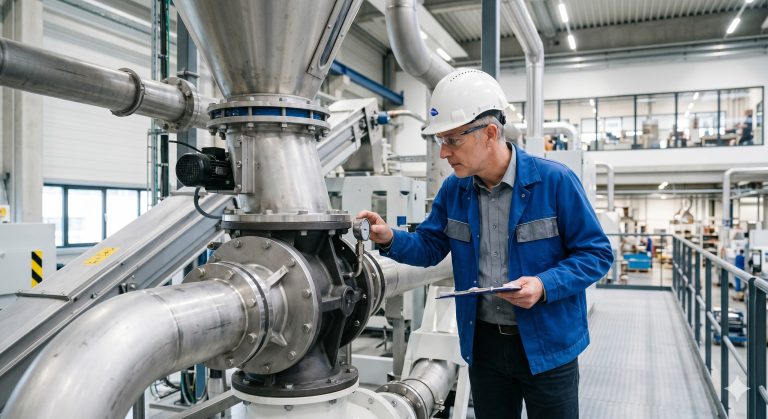
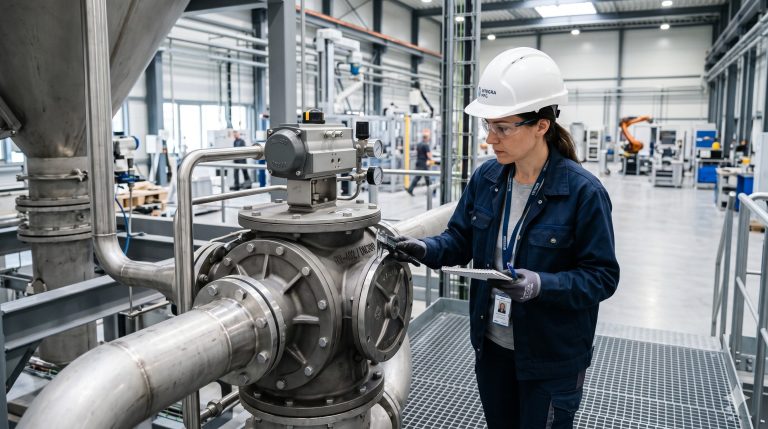
When integrating a rotary valve into an automated feeding system, plant engineers and procurement managers face critical decisions about material compatibility, safety, and long-term reliability. The Doebritz DBR-1237 gravity-fed quick-release rotary valve is engineered to meet these challenges head-on, offering precision clearances, ATEX-certified configurations, and hygienic designs for food and pharmaceutical applications. Below, we address the most common pre-sales and post-sales questions about integrating this valve into your automated line.
Frequently Asked Questions
- Q1: What ATEX certifications does the Doebritz DBR-1237 offer for automated feeding systems in potentially explosive atmospheres?
- The Doebritz DBR-1237 is certified for ATEX Zones 20, 21, and 22, ensuring safe operation in dust explosion hazard areas. It achieves this through a combination of a 16bar pressure-resistant housing, precision rotor-to-housing clearances of 0.1-0.2mm to prevent spark generation, and the option of an ATEX-certified explosion-proof motor.
- Q2: How does the DBR-1237 prevent air leakage (blowback) in a high-pressure dense phase pneumatic conveying system?
- The DBR-1237 maintains a tight rotor-to-housing clearance of just 0.1-0.2mm, which significantly minimizes air bypass and blowback. This precision fit ensures stable pressure differentials, reduces energy consumption, and prevents material flooding in the feeding line, making it suitable for both low-pressure (<0.4 bar) and high-pressure (0.4-1 bar) positive pressure systems.
- Q3: Can the Doebritz DBR-1237 handle highly abrasive materials like lithium battery powders or titanium dioxide without rapid wear?
- Yes, the DBR-1237 is specifically designed to handle abrasive materials. The contact surfaces can be coated with tungsten carbide, ceramic, or high-performance polymers (PE, PTFE, PA). For extreme wear applications, we recommend the tungsten carbide coating option to extend service life and maintain sealing efficiency, providing a cost-effective total cost of ownership (TCO) for abrasive processing.
- Q4: What flange standards are available for integrating the DBR-1237 into an existing automated system?
- The Doebritz DBR-1237 is available with HG20592 standard flanges as a default, and we offer full customization to match your existing system. We can provide flanges to DIN or ANSI standards, as well as custom non-standard heights and drive configurations to ensure seamless mechanical integration into your automated feeding line.
- Q5: How is the rotor-to-housing clearance maintained over time, and how do I adjust it?
- The DBR-1237 is manufactured with an initial precision clearance of 0.1-0.2mm. While this clearance is fixed in the design, Doebritz recommends periodic inspection for wear. Adjustments are not typically field-adjustable; instead, wear is managed through durable materials and coatings. For abrasive duties, we recommend the optional tungsten carbide coating to preserve the critical clearance and maintain low leakage rates over a longer MTBF.
- Q6: What cleaning and maintenance options are available to meet food/pharma GMP standards?
- The DBR-1237 features a true quick-release design that requires no special tools for disassembly, allowing for rapid manual cleaning. For hygienic applications, it supports full CIP (Clean-in-Place) and WIP (Wash-in-Place) protocols. The internal surfaces can be finished to a mirror polish (Ra ≤ 0.4μm) to eliminate dead zones and prevent cross-contamination, making it compliant with 10W, 30W, and C/D class cleanroom environments.
- Q7: How do the outboard bearings and shaft seals perform in automated continuous operation?
- The DBR-1237 is equipped with robust outboard bearings to isolate the bearing housing from the product zone and handle radial loads effectively. The shaft sealing is managed via a lip seal with air purging capabilities. This design prevents material ingress into the bearing area, extends bearing life, and ensures reliable performance in 24/7 automated operations.
- Q8: Can the DBR-1237 be integrated with PLC controls for automated batching and continuous metering?
- Absolutely. The DBR-1237 is designed for full automation integration. It features a variable frequency drive (VFD) compatible motor, allowing for precise speed control. This enables seamless integration with a PLC to achieve accurate flow rate adjustment for gravity discharge, batch metering, and recipe-based automated batching, providing consistent, repeatable material throughput.