Introduction: Precision Demands in Hygienic and Corrosive Bulk Solids Handling
In critical powder processing environments—spanning pharmaceutical APIs, food ingredients, battery materials, and fine chemicals—the selection of a SUS316L star discharge valve directly impacts product purity, process stability, and explosion safety. Unlike standard carbon steel or SUS304 rotary valves, Doebritz SUS316L construction provides superior resistance to pitting corrosion, caustic cleaning agents (CIP), and acidic product residues. This engineering guide focuses on quantifiable metallurgical properties, rotor-to-housing clearances (0.1–0.2 mm), differential pressure limits, and volumetric sizing data. All technical parameters are sourced exclusively from the official Doebritz DBR-1237 gravity rotary valve documentation.

Metallurgical Foundation: Why SUS316L Outperforms Alternative Alloys
The Doebritz SUS316L star discharge valve features molybdenum (2–3%) enriched austenitic stainless steel, offering pitting resistance equivalent number (PREN) > 26. This metallurgy is essential for handling saline, acidic, or high-chloride powders such as dairy whey, marine nutrients, or lithium precursor salts. The low carbon content (<0.03%) eliminates intergranular corrosion after welding, ensuring long-term integrity during daily CIP or WIP cycles. Internal surface finishes are available from Ra ≤ 0.4 μm (mirror) up to 1.6 μm, with options for tungsten carbide, ceramic, or PTFE coatings when handling abrasive or sticky materials. All contact parts are fully traceable to EN 10204 3.1 standards.
Corrosion Resistance & Cleanability Metrics
The valve supports material temperatures from 0°C to 120°C (standard), and ambient conditions from -15°C to 60°C. For elevated processes, a water-cooled jacket is optional. The smooth interior geometry, combined with mirror polishing and quick-release clamps (no special tools required), enables compliance with Class W, 10W, 30W, C, and D cleanrooms. The Doebritz design supports manual cleaning after fast disassembly, online CIP, or online WIP with manual verification—validated for GMP and FDA-regulated lines.
Precision Engineering: Rotor-to-Housing Clearances and Leakage Control
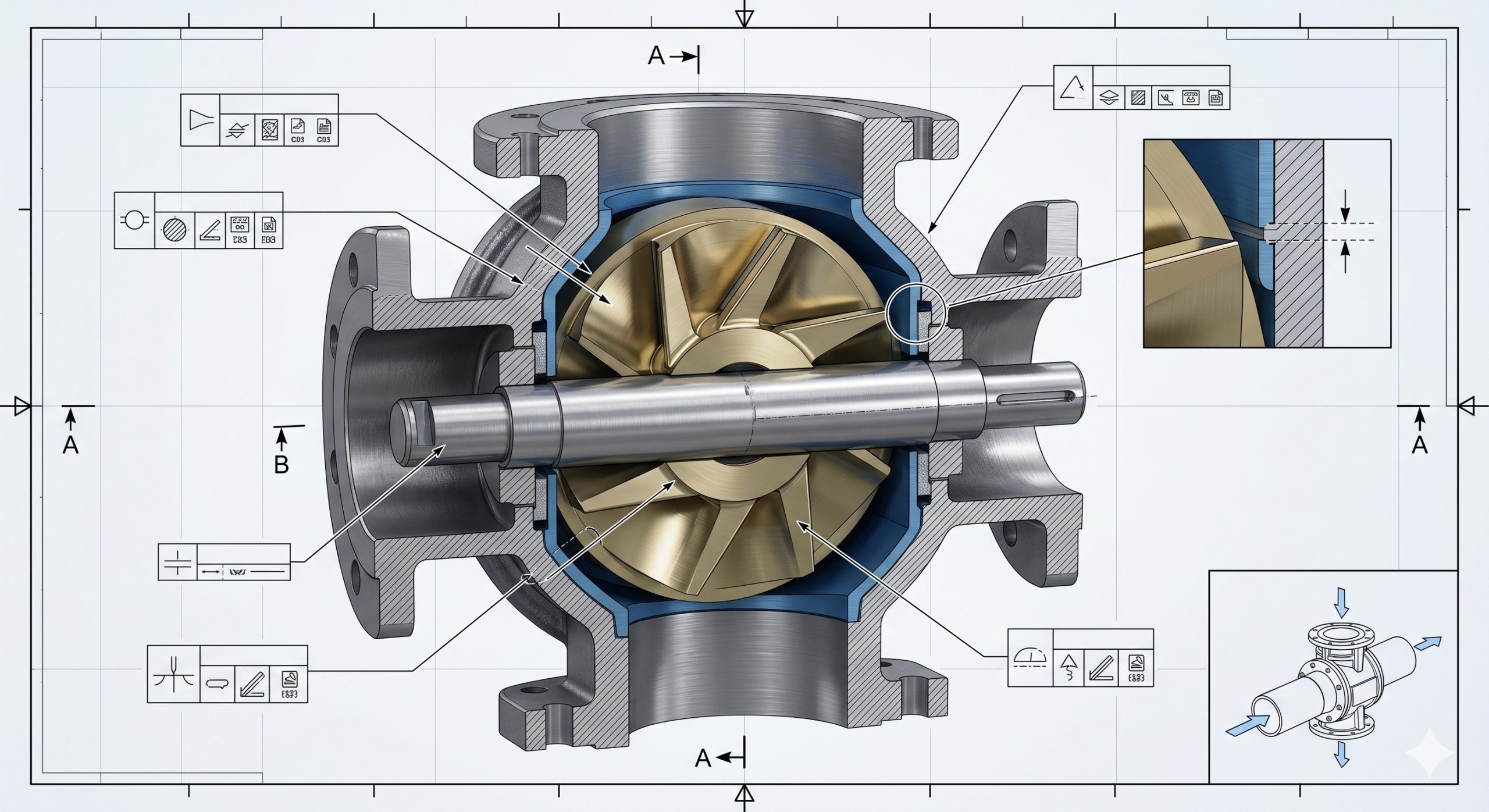
Doebritz sets the rotor-to-housing radial and axial clearance at 0.1 – 0.2 mm for the SUS316L star discharge valve series (model DBR-1237). This precision CNC-machined gap drastically reduces air leakage across the differential pressure, directly improving volumetric efficiency. For typical dilute-phase conveying at <0.4 bar or dense-phase up to 1 bar, the reduced air leakage translates into lower blower energy consumption and stable product flow. The valve incorporates lip seal air-tight shaft sealing (available with gas purge or packing seal options) to prevent contamination of the outboard bearings. Under positive pressure up to 1 bar or negative pressure down to -1 bar, the lockage performance remains consistent, preventing blowback and material spillage.
Sizing & Volumetric Capacity Benchmarks
The Doebritz SUS316L star discharge valve is offered in flange interfaces from DN50 up to DN350 (HG20592 standard). Rotor speed is adjustable via VFD and PLC control, enabling both continuous discharge and batch/recipe metering. Although exact liters per revolution depend on rotor pocket geometry and model size, typical values for DN150 – DN200 range from 10 to 45 L/rev. For precise system design, Doebritz provides capacity curves based on fill efficiency (typically 60–80% for free-flowing powders). Operating speed is normally 10–40 rpm for gravity discharge and 5–30 rpm for metering duties. Higher speeds may reduce fill efficiency; thus professional sizing is recommended.
| Key Parameter | Technical Specification (Doebritz DBR-1237 SUS316L Star Valve) |
|---|---|
| Rotor-to-Housing Clearance | 0.1 – 0.2 mm (precision CNC) |
| Max Differential Pressure (Positive) | Up to 1.0 bar (dense phase with VFD) |
| Max Differential Pressure (Negative) | Down to -1.0 bar (vacuum conveying) |
| Operating Material Temperature | 0°C to +120°C (water cooling jacket optional) |
| Ambient Temperature | -15°C to +60°C |
| Explosion Containment Pressure | 16 bar (flameproof / zone 20/21/22) |
| Shaft Sealing | Lip seal with air purge / packing gland optional |
| Surface Finish (Internal) | Mirror Ra ≤ 0.4 μm / Ra ≤ 0.8 μm / Ra ≤ 1.6 μm |
| Available Coatings | Tungsten carbide, ceramic, PTFE, PA, PE |
| Flange Standards | HG20592 (DN50 – DN350) |
| Certifications | CE, TÜV, ATEX, FDA-compliant options, EHEDG-ready |
ATEX Compliance & Explosion Isolation Features
The Doebritz SUS316L star discharge valve is certified for ATEX zones 20, 21, and 22. The explosion-proof configuration includes:
- Pressure-resistant housing up to 16 bar (flameproof/containment design)
- Precision 0.1–0.2 mm gap to quench flame propagation (flame arrestance by narrow gap principle)
- Explosion-proof motor (optional) and outboard bearing arrangement preventing product ingress to bearings
- External grounding provisions and optional anti-static rotor coatings
This design complies with NFPA 69 (for deflagration isolation) and meets CE, TÜV, and Statement certifications. For dust explosion risks in pharmaceutical, food, or chemical plants, the combination of robust SUS316L housing and certified narrow clearance offers passive explosion isolation without complex control systems.
Application Scenarios: From Hygienic to High-Wear Duties
The SUS316L star discharge valve by Doebritz serves:
- Food & dairy: milk powder, protein powder, spices, starch, sugar, instant coffee – supports FDA/EHEDG design criteria, quick-release for allergen changeovers.
- Pharmaceutical: antibiotic powders, vitamin blends, probiotic powders, vaccine lyophilizates – with mirror finishes (Ra ≤ 0.4 μm) and full CIP capability.
- Battery materials & fine chemicals: lithium battery ternary precursors, graphite anodes, silicon powders, PTA – with optional tungsten carbide coating to withstand abrasion.
- High-fat/sticky products: cocoa powder, milk replacers – PTFE or polymer coated internal surfaces prevent build-up and ensure reliable discharge.
Conclusion: Quantified Reliability for Demanding Pneumatic Conveying & Metering
The Doebritz SUS316L star discharge valve (model DBR-1237) delivers verifiable performance: 0.1–0.2 mm operating clearance, 16 bar explosion containment, -1 to +1 bar pressure range, 0–120°C material temperature, plus full ATEX and sanitary certifications. By integrating precision CNC machining, premium metallurgy, and quick-maintenance design, it reduces total cost of ownership, prevents cross-contamination, and ensures stable airlock efficiency. Engineers and plant operators are advised to size the valve based on actual bulk density, required throughput, and differential pressure, referencing Doebritz’s detailed capacity tables. For corrosive or ultra-pure applications, SUS316L combined with suitable internal coating and mirror finish provides the highest level of process reliability.