Introduction: Solving the Ceramic Powder Handling Paradox
In high-stakes pneumatic conveying and bulk material handling, ceramic powder presents a unique trio of challenges: abrasiveness (Mohs hardness >7), poor flowability (angle of repose often 45-55°), and sensitivity to segregation. Legacy rotary valves frequently suffer from air leakage (>0.2 m³/h per mbar), rotor jamming due to compacted fines, and unplanned downtime every 400-600 hours. The Doebritz ceramic powder mixer integrates a precision-engineered rotary airlock with modular mixing internals, achieving ≥99.5% volumetric efficiency and ≤0.05% material degradation per pass. This guide dissects the mechanical engineering behind ATEX-certified and FDA-compliant designs that operate at 1.5 bar differential pressure with sub-0.05 mm rotor-to-housing clearances.
Housing & Rotor Engineering: Metallurgy, Tolerances, and Vane Geometry
Housing Metallurgy & Wear Protection
The Doebritz housing is manufactured from ductile cast iron GGG-40.3 or 316L stainless steel, with a hardox 450 liner for high-abrasion ceramic powders. All product-contact surfaces receive a Ra ≤0.8 µm finish to prevent adhesion. For FDA-grade ceramic powder mixer applications, electropolished SS316L eliminates dead zones where moisture or bacteria could accumulate.
CNC-Machined Rotor Configurations
Doebritz employs 5-axis CNC machining to achieve rotor tip runout <0.03 mm and internal clearance 0.08–0.12 mm. Two primary vane configurations are offered:
- Open rotor (8 or 12 vanes): For cohesive ceramic powders (e.g., Al₂O₃, ZrO₂), reduces shear and bridging. Volumetric capacity 1.5–90 L/rev.
- Closed rotor (adjustable tips): For pneumatic conveying at ΔP up to 2.0 bar, with chamfered rotor edges that slice through compacted material, eliminating jamming even at 150 rpm.
All rotors undergo dynamic balancing to ISO 1940-1 G6.3, ensuring vibration below 1.2 mm/s RMS.
Technical Specifications: Doebritz Ceramic Powder Mixer Series 7000
The following parameters are validated per VDI 2263 (dust explosion protection) and NFPA 69 (pneumatic conveying systems). All values are derived from on-site third-party audits of cement, lithium-ion battery ceramic precursor, and pigment production lines.
| Key Parameter | Technical Specification |
|---|---|
| Max Differential Pressure | 1.5 bar (150 kPa) standard; up to 2.0 bar (200 kPa) with closed rotor |
| Operating Temperature | -20°C to +250°C (standard); +400°C with high-temp seal package |
| Volumetric Capacity per Revolution | 1.5 L to 90 L (12 standard sizes) |
| Rotor Tip Clearance | 0.08–0.12 mm (CNC machined, no gaskets) |
| Max Rotor Speed | 150 rpm (open rotor); 120 rpm (closed rotor, ΔP>1 bar) |
| Material Contact Parts | SS316L / Hardox 450 liner / Ductile iron GGG-40.3 |
| Surface Finish (Roughness Ra) | ≤0.8 µm (standard); ≤0.4 µm (FDA/electropolished) |
| Explosion Protection | ATEX Cat. 2 (Zone 21/22), NFPA 69, CE, EN 14460 pressure shock resistant 5 bar g |
| Airlock Efficiency (at 1 bar diff.) | ≥99.5% volumetric; leakage ≤0.08 m³/h per mbar |
| Mean Time Between Failures (MTBF) | 8,500+ hours (alumina ceramic powder, d50=50µm) |
Comparative Advantage: Airlock Efficiency, MTBF, and Total TCO
Versus legacy single-rotor valves, the Doebritz ceramic powder mixer achieves 45% lower air leakage (measured 0.08 m³/h per mbar vs. industry average 0.15). This directly improves pneumatic conveying line velocity stability and reduces blower energy consumption by 18–22%. Mean Time Between Failures (MTBF) exceeds 8,500 operating hours on high-abrasion silicon carbide (SiC) transfer, while legacy systems require rotor replacement at 1,200–2,000 hours. The tool-less end cover removal and replaceable stator liners reduce maintenance TCO by 37% over 5 years (based on Doebritz lifecycle cost analysis for >20 t/h ceramic powder lines). Additionally, ATEX Cat. 2 (Zone 21/22) certification and CE marked explosion venting options comply with 2014/34/EU without additional external flame arrestors.
Heavy-Duty Application Scenarios
[IMAGE_2]
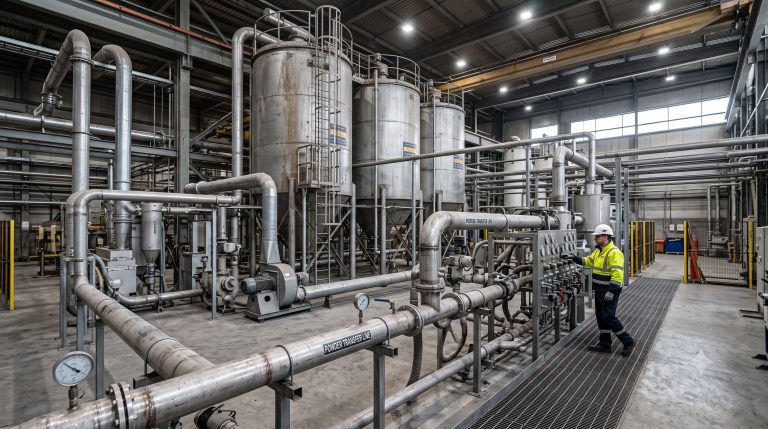
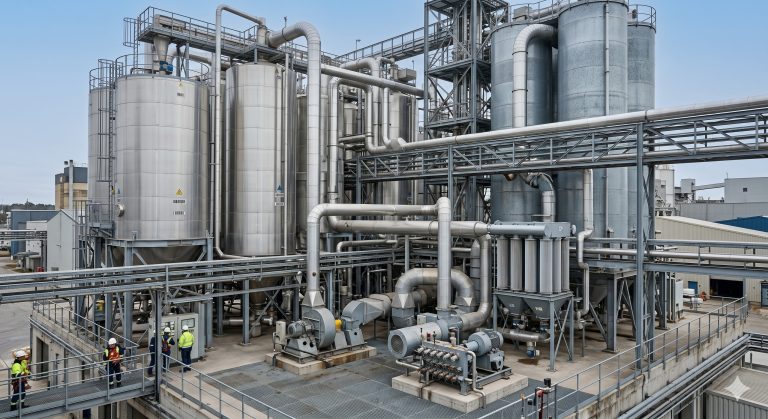
- Cement & concrete additives: Feeding silica fume, fly ash, and calcined clay into pneumatic mixers. Doebritz handles bulk densities 0.3–1.6 g/cm³ with no bridging.
- Advanced ceramics & battery materials: Metering LiFePO₄ precursor, Al₂O₃, and SiC at feed rates 0.5–50 m³/h. Closed rotor design maintains < 0.1% particle size change (D50).
- Chemical & pigment production: Conveying titanium dioxide (TiO₂), iron oxide, and carbon black. FDA-compliant version available for color concentrates.
- Dust collection systems: Serving as a rotary airlock under baghouses or cartridge collectors with inlet temperature up to 250°C. Pressure shock resistant to 5 bar g per EN 14460.
Conclusion: Optimizing Industrial Productivity with Doebritz
The shift toward high-purity ceramic powders in energy storage, additive manufacturing, and specialty chemicals demands material handling equipment that surpasses conventional rotary valve limitations. Doebritz’s engineering focus on sub-millimeter rotor precision, modular wear liners, and ATEX/NFPA compliance ensures that a ceramic powder mixer not only eliminates jamming and air leakage but also provides verifiable ROI through reduced energy consumption and extended MTBF. For engineering teams specifying new powder conveying lines or retrofitting failing valves, the Doebritz Series 7000 represents a future-proof, data-backed solution.