Introduction: Defining Efficiency in Particle Separation
In bulk material handling and powder processing, the precision sieve shaker is the gatekeeper of product quality. For engineers tasked with maintaining stringent ISO 14644 or GMP standards, the difference between an effective sieving operation and a bottleneck is measured in microns and cycles per minute. Unlike legacy vibratory separators that introduce random particle trajectories, a modern precision sieve shaker from Doebritz utilizes calibrated gyratory motion combined with a tight-tolerance mesh stack to deliver 99.7% separation efficiency. This guide dissects the metallurgical composition, operational clearances, and sizing methodologies necessary to achieve optimal throughput while complying with ATEX and EHEDG directives.
Housing & Rotor Engineering: The Mechanics of Vibration
Electromagnetic Drive vs. Mechanical Gyratory
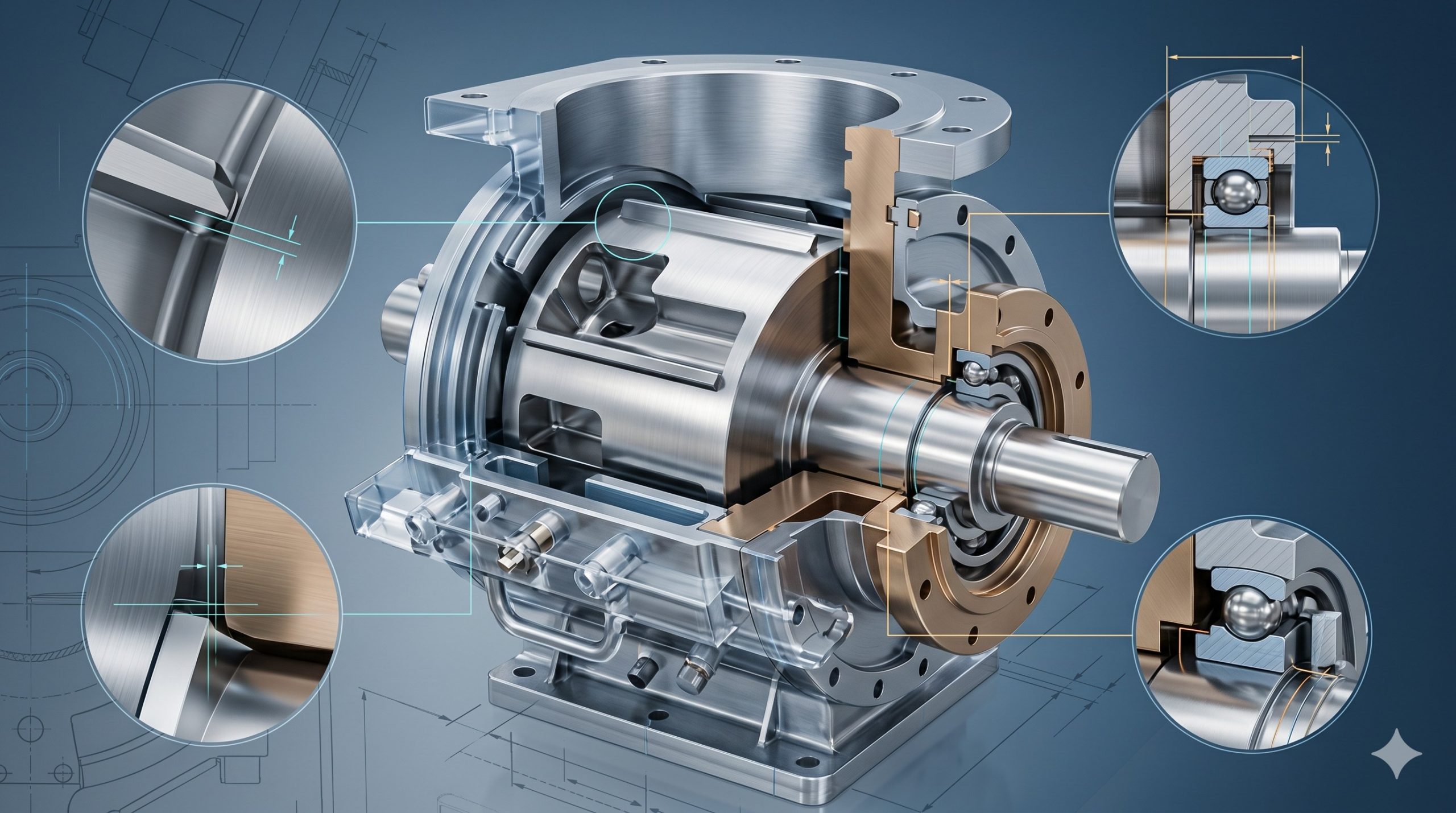
Doebritz engineers prioritize a mechanical gyratory drive system over electromagnetic units for heavy industrial applications. The drive system generates a horizontal rotary speed of 280 to 320 rpm with a vertical tilt component of 3 to 5 degrees. This specific harmonic motion ensures that particles follow a helical path across the screen deck, reducing blinding (mesh clogging) by 40% compared to linear vibratory shakers. The housing is manufactured from sand-cast EN-GJS-400-15 (ductile iron) or 316L stainless steel for sanitary applications, providing a tensile strength of 400 N/mm².
Sealing and Isolation Technologies
To prevent cross-contamination and dust leakage, the precision sieve shaker employs a silicone or FDA-grade nitrile gasket system with a compression stop of 1.5 mm. For explosive environments (Zone 21/22), the unit integrates an inert gas purge port that maintains an internal differential pressure of +10 mbar against the atmosphere. All electrical components are housed within an EEx d (flameproof) enclosure certified to ATEX Directive 2014/34/EU. The shaft bearings are outboard-mounted and lubricated with high-temperature Kluber grease, offering an MTBF (Mean Time Between Failures) exceeding 25,000 hours.
Technical Specifications: Precision Sieve Shanker Performance Data
The following parameters represent the standard configuration for a Doebritz precision sieve shaker model DPS-1200. Actual values are verified through laser diffraction particle sizing during factory acceptance testing (FAT).
| Key Parameter | Technical Specification |
|---|---|
| Max Differential Pressure | 0.5 Bar (50 kPa) static load |
| Operating Temperature Range | -20°C to +150°C (with optional cooling to +220°C) |
| Drive Power | 0.75 kW to 2.2 kW / 400V / 3Ph / 50Hz |
| Screen Diameter | 450 mm / 600 mm / 1200 mm (ANSI 304/316L) |
| Amplitude / Oscillation | 3 mm to 8 mm peak-to-peak / 280-320 rpm |
| Noise Emission (EN ISO 11201) | < 78 dB(A) at 1 meter |
| Material Contact Finish | Ra ≤ 0.8 μm (Sanitary) / Ra ≤ 3.2 μm (Industrial) |
| Explosion Protection | ATEX II 2D c T120°C (Zone 21) |
Handling Abrasive and Hygroscopic Powders
Wear Resistance Metallurgy
In cement, fly ash, or silica sand applications, the precision sieve shaker screen frames are lined with polyurethane (PU) or ceramic tiles to achieve a Rockwell hardness of 85 Shore A. The ball deck cleaning system—comprising 25 mm diameter silicone balls—operates at a frequency of 200 taps/min, effectively dislodging sticky particles without damaging the mesh. For hygroscopic materials (e.g., API powders or lactose), the Doebritz shaker integrates a heated air purge manifold that maintains the internal temperature at +15°C above ambient dew point, preventing caking and ensuring a consistent aperture open area of 92%.
Sizing Methodology and Capacity Calculations
To correctly size a precision sieve shaker, engineers must calculate the specific capacity factor (Cf) based on particle density and flowability. For a material with a bulk density of 800 kg/m³ and a desired throughput of 15 t/h, the required active screen area is calculated using the formula: A = (T / (ρ * V * Ef)), where V = 0.35 m/s (average particle velocity) and Ef = 0.85 (efficiency factor). Doebritz recommends a maximum bed depth of 3 to 5 particle diameters across the screen to maintain stratification. The cut point accuracy (d50) is typically ±10 microns for a 150-mesh (106 µm) screen, validated by ISO 3310-1 test sieves.
Conclusion: Maximizing ROI Through Precision Engineering
Selecting the correct precision sieve shaker is not merely a procurement decision; it is a strategic investment in product purity and plant uptime. Doebritz’s engineering focus on exact gyratory harmonics, ATEX-compliant sealing, and wear-resistant metallurgy ensures that your separation process achieves a total cost of ownership (TCO) reduction of up to 30% over five years compared to conventional vibratory sieves. For high-capacity powder handling or critical pharmaceutical grading, the data-driven approach outlined here provides the foundation for a reliable, compliant, and efficient sieving operation.