Overview
Doebritz carbon steel painted quick-release rotary valves are engineered for heavy-duty industrial applications requiring reliable lock-up, abrasion resistance, and easy maintenance. This FAQ addresses the most critical technical, safety, and procurement questions from plant engineers and maintenance managers.

Frequently Asked Questions
- Q1: What are the standard and custom flange options for Doebritz carbon steel painted quick-release rotary valves? Does Doebritz support DIN and ANSI?
- Doebritz carbon steel painted quick-release rotary valves are available with HG20592 standard flanges as base, with full support for DIN, ANSI, JIS, and other custom flange standards upon request. Standard sizes include DN50, DN100, DN150, DN200, DN300, and DN350. Doebritz offers complete flange customization to match existing process connections, including non-standard drilling patterns, facing finishes, and raised-face or flat-face configurations, ensuring seamless retrofit without line modification.
- Q2: Is the Doebritz carbon steel painted quick-release rotary valve ATEX certified for explosive dust environments?
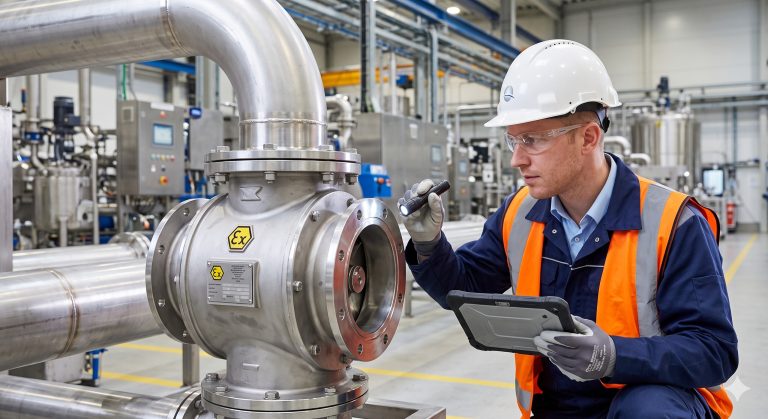
- Yes, Doebritz carbon steel painted quick-release rotary valves are ATEX certified for Zones 20, 21, and 22. The explosion-proof configuration includes a pressure rating of 16 bar, precision rotor-to-housing clearance of 0.1–0.2 mm, and an ATEX-certified explosion-proof motor. This design provides flame propagation isolation and mechanical spark containment, making the valve suitable for handling combustible dusts such as carbon black, organic pigments, and fine chemical powders in classified hazardous areas.
- Q3: What is the standard rotor-to-housing clearance, and can it be adjusted for different materials?
- The standard rotor-to-housing clearance for Doebritz carbon steel painted quick-release rotary valves is 0.1–0.2 mm (100–200 microns). This precision gap is factory-set to minimize air leakage while preventing rotor jamming. For fine powders below 50 microns, Doebritz can reduce clearance to 0.08 mm. For materials with thermal expansion or sticky characteristics, clearance can be increased to 0.25–0.3 mm. Clearance is not field-adjustable; any modification requires factory recalibration or replacement of precision-matched components.
- Q4: How does the Doebritz carbon steel painted quick-release rotary valve perform with highly abrasive materials like coke, cement, or minerals?
- For highly abrasive materials, Doebritz offers wear-protected variants including tungsten carbide coating, ceramic coating, or high-molecular polymer liners applied to the carbon steel housing. Standard carbon steel painted construction provides moderate abrasion resistance suitable for materials up to 300 HV. For severe abrasive applications—petroleum coke, silica, alumina, or iron ore—Doebritz recommends the tungsten carbide coated version (hardness up to 1,300 HV) which extends service life 5–8 times compared to standard carbon steel. The quick-release design allows rapid rotor replacement when wear eventually occurs.
- Q5: How do I maintain the outboard bearings and shaft sealing system?
- Doebritz carbon steel painted quick-release rotary valves feature outboard bearing housings isolated from the material flow path. Bearings require regreasing every 2,000 operating hours using NLGI 2 lithium-complex grease. The shaft sealing system uses lip-type air-tight seals with optional purge air connection. For purge operation, maintain 0.2–0.5 bar positive air pressure to prevent dust ingress. Inspect lip seals every 6 months for wear; replacement requires removing the quick-release end cover—no special tools needed. The outboard bearing design ensures bearings never contact conveyed material, extending bearing life to 25,000+ hours in typical service.
- Q6: What is the typical lead time and what documentation is provided for a custom Doebritz carbon steel painted quick-release rotary valve?
- Standard Doebritz carbon steel painted quick-release rotary valves with DN100–DN200 flanges ship within 15–20 working days. Custom configurations—including non-standard flanges, wear coatings, or ATEX certification—require 25–35 working days. Every Doebritz valve ships with: material certificate EN 10204 3.1 for carbon steel components, inspection test report, ATEX certificate (if ordered), dimensional certification report, and operating/maintenance manual. Additional documentation such as NDT reports, positive material identification (PMI), or surface roughness certificates are available upon request with a 3–5 day lead time.
- Q7: Can the Doebritz carbon steel painted quick-release rotary valve be used for both pressure and vacuum pneumatic conveying?
- Yes, the Doebritz carbon steel painted quick-release rotary valve is designed for bidirectional service. For positive pressure: low-pressure up to 0.4 bar, high-pressure from 0.4 to 1.0 bar with VFD speed control. For negative pressure (vacuum): low-pressure greater than -0.4 bar, high-pressure from -1.0 to -0.4 bar with VFD control. The precision clearance and shaft sealing system maintain leakage rates below 0.01 m³/m²/h at 0.6 bar differential, ensuring stable dilute-phase or dense-phase conveying without blowback or vacuum collapse.
- Q8: What is the maximum operating temperature for Doebritz carbon steel painted quick-release rotary valves?
- The standard Doebritz carbon steel painted quick-release rotary valve operates at ambient temperatures from -15°C to 60°C and material temperatures from 0°C to 120°C. For applications exceeding 120°C, Doebritz offers an optional water-cooled jacket that maintains housing temperature below 100°C even with material temperatures up to 250°C. For high-temperature applications above 250°C, Doebritz recommends stainless steel construction with specialized high-temperature seals and increased thermal clearances. Note that carbon steel painted finish is rated for continuous service up to 200°C; above this, paint may discolor but protective function remains.
Technical Summary for Procurement
When sourcing Doebritz carbon steel painted quick-release rotary valves, specify: connection flange standard (DIN/ANSI/HG20592) and size, pressure range (positive or vacuum), material characteristics (abrasiveness, temperature, particle size), ATEX zone requirement, and any coating needs. Doebritz provides full engineering support for custom configurations including non-standard inlet/outlet heights, VFD-ready motors, and purge air connections.