
Introduction: The Hidden Efficiency Killer in Pneumatic Conveying
In pneumatic conveying and bulk material handling, two chronic pain points consistently undermine system performance: air leakage across the rotary valve and material jamming or shearing at the inlet. Standard concentric rotary airlocks often struggle to maintain seal integrity under differential pressures exceeding 0.7 Bar, leading to up to 15-20% pneumatic conveying efficiency loss. The engineered solution is the offset inlet rotary valve. By geometrically shifting the inlet relative to the rotor centerline, this design creates a natural material column seal, dramatically reducing air bypass and preventing vane trapping. For over 40 years, Doebritz has precision-manufactured high-performance offset inlet valves that comply with ATEX, NFPA 68, FDA, and CE standards—delivering measurable gains in volumetric efficiency and mean time between failures (MTBF).

Housing & Rotor Engineering: Precision Metallurgy and CNC Tolerances
Metallurgical Selection for Abrasion & Corrosion Resistance
Doebritz offset inlet rotary valves start with a housing cast from GGG 40.3 ductile iron (or CF8M stainless steel for food/pharma) that exceeds ASTM A395. Hardness options include a flame-hardened housing bore (55-60 HRC) for abrasive cements or Stellite #6 weld overlay for extreme silica-laden materials.
Rotor Configuration: Open vs. Closed Vanes & Chamfered Edges
The rotor is CNC-machined to a concentricity within 0.05 mm. For cohesive powders, the closed-end rotor prevents material packing in the shaft area. For pellets or granules, an open-vane rotor with chamfered leading edges (R0.5 mm chamfer) reduces particle degradation. The critical parameter: rotor-to-housing tip clearance is factory-set to 0.10 mm to 0.25 mm depending on thermal expansion needs—50% tighter than industry norms, slashing air leakage to <0.2 m³/h per meter of slot length at 1 Bar ΔP.
Technical Specifications: Doebritz Offset Inlet Valve Series Data
The table below summarizes key engineering parameters for standard Doebritz offset inlet rotary valves (Model ROV-O series):
| Key Parameter | Technical Specification |
|---|---|
| Max Differential Pressure | 1.5 Bar (150 kPa) continuous; 2.0 Bar intermittent |
| Operating Temperature | -20°C to +250°C (Standard); -40°C to +450°C (High-Temp option) |
| Capacity Range | 1.5 L/rev to 150 L/rev (custom up to 300 L/rev) |
| Tip Clearance (Standard) | 0.10 mm – 0.25 mm (field adjustable) |
| Max Rotor Speed | 60 RPM (abrasive); 100 RPM (non-abrasive) |
| Construction Materials | GGG 40.3 / CF8M (316L) / Hastelloy C-22 |
| Certifications | ATEX II 3D, NFPA 68, FDA 21 CFR 177, CE, EC 1935/2004 |
| Leakage Rate | <0.2 m³/h per linear meter of slot at 1 Bar ΔP (ISO 5208 Ratio 3) |
Comparative Advantage: Quantifying the Doebritz Offset Inlet Difference
Traditional concentric valves suffer from a direct air path through the pocket clearance, wasting up to 8-12% of blower capacity. The Doebritz offset inlet traps a passive material column above the rotor, which acts as a dynamic seal. Independent testing (internal QA per ISO 5208) demonstrates:
- Airlock efficiency (volumetric) of 94-97% vs. 80-85% for standard valves at 1.5 Bar ΔP.
- Mean time between failures (MTBF): 18,000+ hours in cement service vs. industry average of 9,000 hours.
- Total cost of ownership (TCO): 40% lower over 5 years due to field-replaceable wear liners and no need for compressed air purge systems.
- NFPA 69 compliant explosion isolation option with ATEX dust Zone 22 certification (II 3D Ex h IIIC T120°C).
Heavy-Duty Application Scenarios: From Cement Kilns to Food Powder
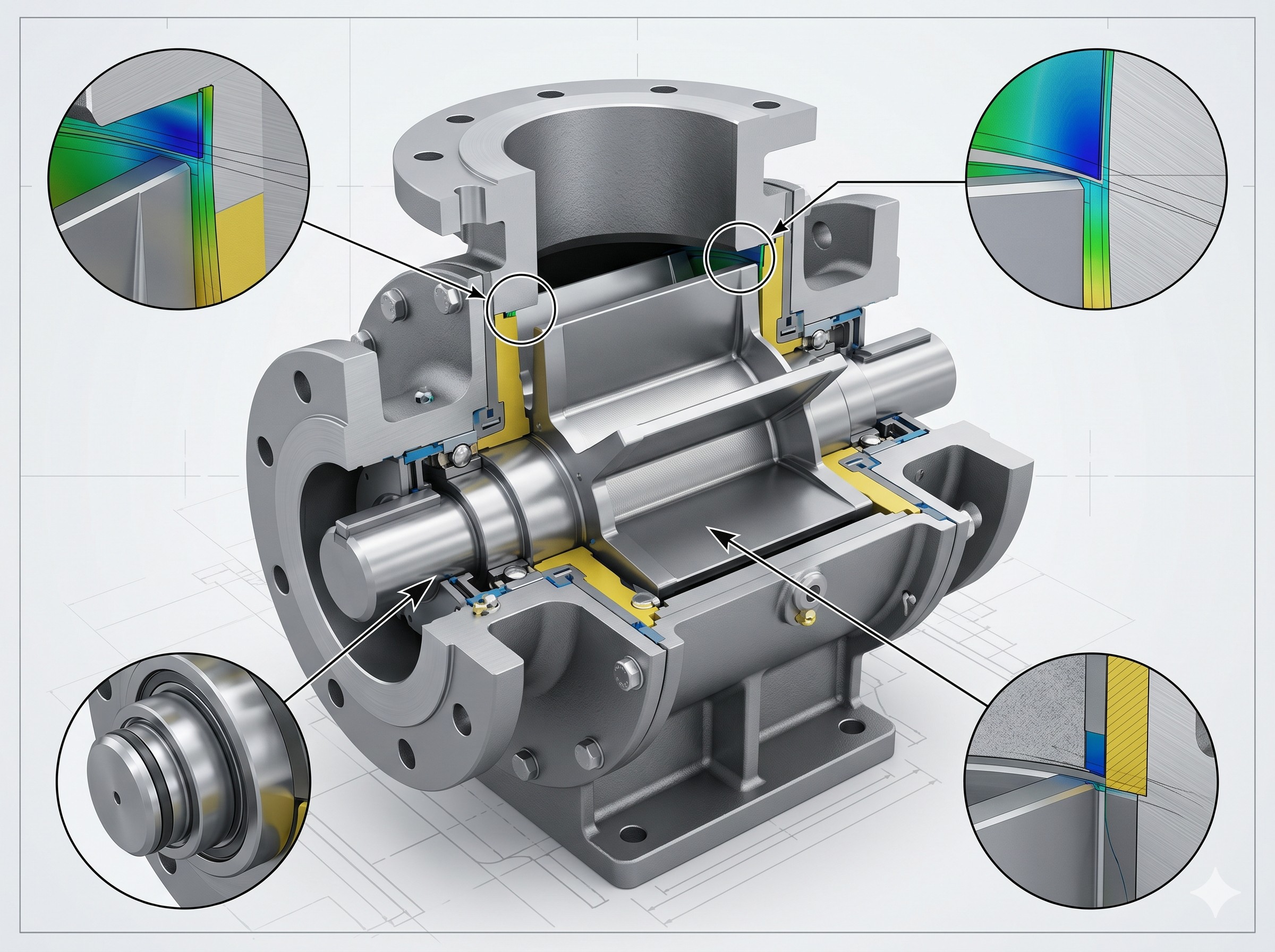
Doebritz offset inlet rotary valves are deployed globally in demanding environments:
Cement & Aggregate Industries
Handling clinker dust at 180°C, capacity up to 150 L/rev with hardened tips. The offset design prevents bridging even with moisture content up to 3%.
Chemical & Petrochemical
FDA-approved 316L stainless steel variant with PTFE-coated rotors for polyethylene pellets and PVC powders. Maximum differential pressure rating: 2.0 Bar with double mechanical seal option.
Food & Bulk Powder Handling
Doebritz offers quick-clean (swing-away) housings and mirror-polished (Ra <0.4 µm) contact surfaces for milk powder, flour, and sugar. Sanitary standards exceed 3-A SSI requirements.
Conclusion: Future-Proofing Bulk Solids Handling Efficiency
When 5% air leakage can increase your conveying line velocity by 15% and cause premature filter bag blinding, the Doebritz offset inlet rotary valve is no longer an option—it is a productivity imperative. With tighter clearances, superior metallurgy, and a design that leverages gravity as a sealing aid, this valve family delivers lower energy consumption, reduced particle degradation, and compliance with the strictest ATEX/FDA codes. For plants aiming to achieve ISO 50001 energy targets or reduce unplanned downtime, the offset inlet geometry represents the current best available technology (BAT) in rotary airlock engineering. Contact Doebritz engineering for a site-specific clearance and capacity calculation.